
Metal Roofing Guide — Charleston, SC
How long does a copper roof last? The sheet metal can run past 100 years — American copper roofs installed in 1899 and 1907 are still in service. The assembly holding it does not. Rubber pipe boots commonly crack within 10 to 20 years, underlayment is generally estimated at 30 to 50, and Charleston’s salt air attacks every point where copper meets aluminum or galvanized steel. Big Bear Roofing inspects the shingle and metal roof system your copper ties into.
Updated October 2026 · 18 min read · GAF Master Elite contractor
Key points
- The “100 years” figure describes copper sheet. It has never described the underlayment, cleats, solder, or flashings that keep water out.
- Salt air is an electrolyte. Coastal marine air is normally classed C4 (high) or C5 (very high) for atmospheric corrosivity under ISO 9223, and that is what makes dissimilar-metal contact so destructive here.
- Copper is a noble metal. Put it against aluminum, zinc, or galvanized steel and the other metal dissolves — sometimes without ever touching, just from runoff.
- Only copper, brass, bronze, or non-magnetic 300-series stainless fasteners belong in copper work.
- Green patina is the protective layer forming, not a sign of failure. On the coast it is a different mineral than it is inland.
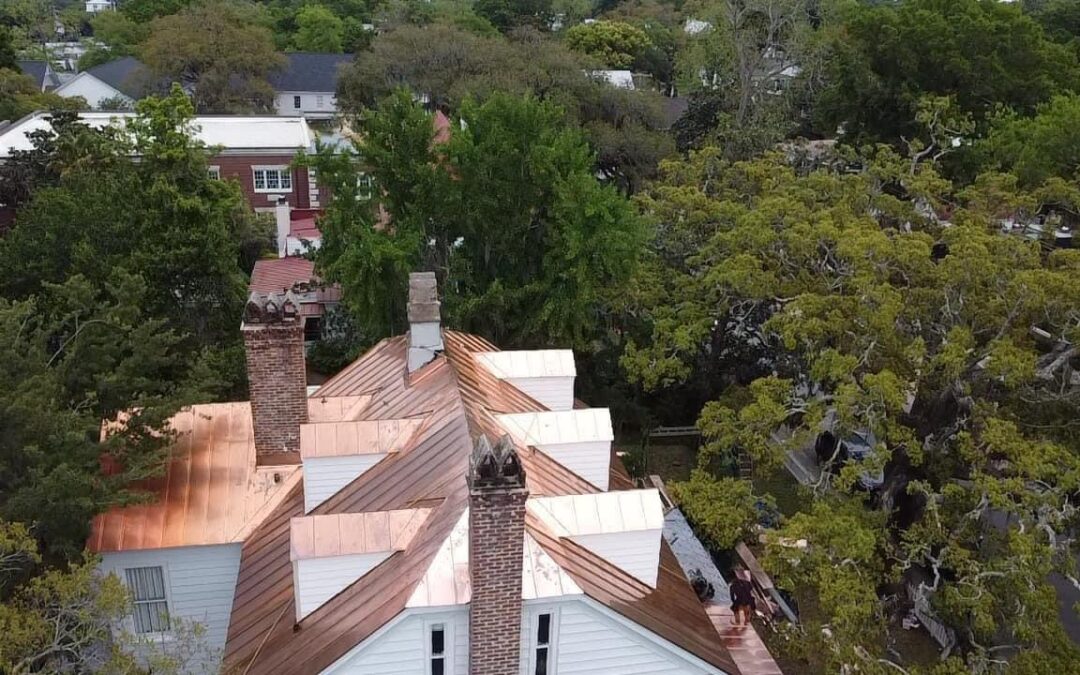
- Copper often shows up on Charleston homes as accent work — a bay cap, a dormer, a porch, a turret — sitting in a shingle or metal field. Where those two systems meet is where the leaks start.
Most of what you will read about copper roofing is a single unqualified sentence: copper roofs last 100+ years. It is not wrong, exactly. It is just answering a different question than the one you asked.
You want to know how long your copper will keep water out of your house, in Charleston’s coastal, salt-air environment. That is a question about an assembly — sheet, seams, solder, clips, underlayment, fasteners, and the flashings where the copper meets everything else. The copper sheet is normally the longest-lived item on that list by a wide margin — but it is not the item that decides when your roof leaks.
Here is how the whole thing actually ages on the South Carolina coast, and what a real inspection looks at. The code editions, standards, and city policies below reflect what was in force in September 2026.
What “100 Years” Actually Describes — the Metal, Not the Roof
Where the century figure comes from
The century claim is real, and it is well documented. The Copper Development Association and comparable technical sources confirm that well-installed copper roofs frequently perform for more than 100 years, with civic and institutional examples running longer than that. The buildings usually cited include the New York State Capitol central courtyard in Albany, completed in 1899, the Logan County Courthouse in Lincoln, Illinois, completed in 1905, Harvard Law School’s Langdell Hall in Cambridge, built in 1907, and Maury Hall at the United States Naval Academy in Annapolis, also 1907.
The reason is simple chemistry. Copper contains no iron, so it cannot rust. It still corrodes — but instead of flaking away, it builds a stable, self-renewing surface layer of copper compounds, the patina, that sharply slows the corrosion underneath. That gives copper one of the longest expected service lives of any roofing material, well past the 15 to 30 years typical of asphalt shingles and the 50-plus years typical of aluminum.
The figure describes sheet metal, not a roof system
Read that claim carefully and you will notice what it does not cover. A copper panel might sit there for 150 years. The synthetic membrane under it will not. The sealant at the pipe penetration will not. The solder in a flat-seam pan may not, if the panel it joins is fighting thermal movement every day. And the wood deck holding all of it up is only as good as how dry it has been kept — a deck that has taken water repeatedly is on a far shorter clock than the metal above it.
The correct way to state it: copper sheet can outlast a century. A copper roof is only as durable as its weakest detail. That distinction is the entire subject of this article, and it is the part every generic answer leaves out.
Sixteen ounces or twenty: how copper is actually specified
Steel and aluminum are sold by gauge. Architectural copper is sold by weight per square foot, and the minimum thickness for each weight class is set by ASTM B370. Roofing copper is normally specified in a cold-rolled temper (designated H00), which is stiffer and stronger than soft copper and stands up to being walked on and formed.
| Designation | Nominal thickness | Rough gauge equivalent | Where it is normally used | How it behaves |
|---|---|---|---|---|
| 16 oz cold-rolled | 0.0216 in. (1.00 lb/sq ft) | ~24 gauge | Standard flashings, small dormer roofs, hung gutters and downspouts | Very workable, easy to form and solder; more prone to visible waviness (“oil canning”) on wide spans |
| 20 oz cold-rolled | 0.0270 in. (1.25 lb/sq ft) | ~22 gauge | Larger panels, extended overhangs, high wind-load coastal work, built-in (Yankee) gutters | About 25% more metal; noticeably stiffer, resists denting and oil canning |
Sixteen ounce is the residential baseline. Twenty ounce is what is generally called for on wide pans, long overhangs, built-in gutters, and high wind-load coastal work. The right weight on any given roof is not a rule of thumb, though — it follows from the panel geometry, the span, the substrate, the calculated wind pressures for that specific building, and the tested assembly the specification calls out.
What the coast does to the patina
New copper is a bright salmon pink. It darkens through brown to near-black, then eventually turns green or blue-green. That color change is not decay. It is the protective layer forming.
What changes on the coast is the chemistry. Inland, patina is mostly basic copper sulfates — the mineral brochantite — formed by reaction with atmospheric sulfur dioxide. In Charleston’s marine air, heavy with sea salt and humidity, the patina is dominated instead by basic copper chlorides: the minerals atacamite and clinoatacamite. That is what the luminous blue-green on peninsula porticos and steeples actually is.
Two consequences follow. First, the timeline is not fixed — a coastal roof can start greening within a few years while an inland roof takes decades, depending on moisture, wind direction, and how much chloride is landing on it. Anyone who quotes you a fixed number of years to green is guessing.
Second, that chloride patina can be more porous and less uniform than an inland sulfate patina. In severe marine atmospheres with heavy salt deposition and constant wet-dry cycling, researchers have documented heterogeneous chloride-rich layers, and at the most extreme coastal test sites, flaking of the corrosion-product layer. Coastal marine sites are typically classed C4 or C5; where any specific Charleston property actually lands depends on measured exposure at that address, not on a map. Either way, it is a reason the flat, unqualified “copper is permanent” line does not survive contact with the coast.
Runoff stains everything it lands on
Rain running off copper picks up trace copper salts. If that water drips onto light brick, stucco, painted fascia, or landscaping, it leaves a deep blue-green stain that is very hard to remove. The fix is drainage design, not cleaning: copper gutters, adequate drip edges, and overhangs that carry water away from the wall rather than down it. If you already have staining under a copper bay or turret, the detail above it is telling you where the water is going.
Salt Air and Dissimilar Metals: The Galvanic Rule That Decides Coastal Copper
This is the section that decides whether coastal copper lasts. If you read nothing else, read this.
Three conditions, and Charleston supplies one of them for free
Galvanic corrosion is a battery. A battery makes power by putting two different metals in a salty or acidic liquid; electrons move from the weaker metal to the stronger one, and the weaker metal dissolves. A roof does the same thing when three conditions line up:
- Two dissimilar metals are present.
- They are in electrical contact.
- An electrolyte bridges them.
Inland, condition three is intermittent. On the Charleston coast it is the default. Airborne salt aerosol makes an aggressive electrolyte, which is why standard environmental classification puts coastal marine sites at ISO 9223 category C4 (high) or C5 (very high) atmospheric corrosivity. Every bare metal on the building corrodes faster here than it would in the Midlands.
Where copper sits, and what that means for its neighbors
In the galvanic series — the ranking of metals by electrical potential — copper sits high, among the noble metals. Aluminum, zinc, and galvanized steel sit far below it. When copper contacts one of those in salt air, the less-noble metal becomes the sacrificial anode and corrodes rapidly to protect the copper.
- Passivated 300-series stainless (304, 316) is actually slightly more noble than copper, so copper is technically the sacrificial metal in that pair. The potential difference is small and the mass of a copper roof dwarfs the mass of its fasteners, so the rate is negligible. That is why 300-series stainless is safe and recommended with copper. Active or 400-series stainless is a different metal and is not.
- Lead sits just below copper. The gap is so small that lead and lead-tin solder react extremely slowly and coexist with copper for decades.
- Steel, aluminum, and zinc sit far below copper. The voltage gap is large, and the result is fast, destructive corrosion of the active metal.
The four failure paths we actually find
In every one of these couples, copper corrodes far more slowly than its neighbor does. It is the metal around the copper that dies.
- Copper fasteners in a steel or Galvalume panel. The steel becomes the anode and corrodes outward from every hole. The attachment point disappears, and the panel is free to peel in a wind event.
- Copper touching aluminum. An aluminum gutter hung under a copper valley, or an aluminum drip edge lapped over copper flashing, pits and dissolves.
- Copper runoff onto metal below. No contact required. Water running off copper carries copper ions; where it lands on a galvanized lower roof, aluminum siding, or a zinc-coated flashing, it starts corroding that surface. This is the one homeowners never see coming, because the two metals are feet apart.
- Galvanized or aluminum screws in copper. The fastener is the anode, so the fastener is what fails. The copper stays perfect while the roof loses its grip on the deck.
Fasteners and isolation
The rule is short. Fasteners in copper work must be copper, brass, bronze, or non-magnetic 300-series stainless steel. Nothing else.
Where copper has to sit near a dissimilar metal that cannot be replaced, the two must be physically separated so there is no conducting path — a dielectric barrier, a separating membrane, or a heavy elastomeric coating. Separation is cheap at installation and expensive later.
The Parts That Age Out First: Underlayment, Fasteners, Seams, and Flashing
Neither the Copper Development Association, SMACNA, nor ASTM publishes a fixed lifespan for a cleat, a seam, or a flashing — because those are decided by design and workmanship, not by a clock. Detailed correctly, a compatible cleat or a well-made soldered seam can go the distance with the roof. Detailed badly, either can fail in a few seasons. What is not in dispute is that these are the points where roofs of this kind actually fail.
The underlayment: a 30-to-50-year part under a 100-year metal
Old copper work used rosin-sized slip paper: a heavy kraft-fiber sheet set in alum that separated the metal from resins in the deck and kept the roof from squeaking as it moved. It was never a moisture barrier.
Modern code does not allow that as the whole answer. Under the 2021 International Residential Code — adopted in South Carolina effective January 1, 2023 — metal roof assemblies require a compliant underlayment, with the code citing ASTM D226, ASTM D4869, and ASTM D1970 for self-adhering polymer-modified bitumen membranes.
There is a copper-specific wrinkle. Copper absorbs and holds a lot of solar heat, and standard asphaltic underlayments can soften or off-gas under it — degrading the membrane, or worse, bonding the copper to the deck and killing the thermal movement the panels depend on. High-temperature synthetic underlayments or high-heat self-adhered membranes are what belong under copper.
Even the good ones are generally estimated at 30 to 50 years of service life. Do the arithmetic: a 100-year copper roof will outlive its own waterproofing layer by decades, and possibly twice. That single fact is why “copper is permanent” is a bad way to plan.
Cleats, thermal movement, and the 10-foot line
Copper moves. Its coefficient of thermal expansion is 0.0168 mm/m/°C, and over a long pan that adds up to real travel every single day. If the panel cannot move, something has to give, and it will be the seam.
Panels are held by cleats, typically spaced 12 inches on center. There are two kinds, and choosing wrong is the most common way a copper roof gets ruined early:
- Fixed cleats are nailed rigidly to the deck and folded into the seam. Sheet-metal practice limits them to short pans — commonly cited at a maximum of about 10 feet.
- Expansion (sliding) cleats use a sliding tab that lets the panel glide across the deck. Past that 10-foot boundary they are not optional.
Fixed cleats on a long run do not leak on day one. They work-harden the metal at the seam, season after season, until fatigue cracks open. Primary sources do not publish a service life for a cleat at all — performance depends on alloy compatibility, thickness, fastening, corrosion exposure, and how much cyclic movement it has to absorb. What they do establish is the failure mechanism: a fixed cleat on a 20-foot pan is a known way to crack seams early.
Seams and solder
Standing seam, flat-lock, and batten seam are all joints, and joints are where roofs leak. Low slope changes the answer. Traditional copper standing seam carries a minimum-slope limitation, and at roughly 3-in-12 (about 14 degrees) or less the usual solution is soldered construction — flat-seam pans, or a panel system specifically tested and approved for that slope with its transverse joints soldered. Whether a given seam gets soldered follows from the system, the slope, and the approved detail, not from one blanket rule.
Solder for copper is specified as 50/50 tin-lead, or as pure tin or a lead-free high-tin alloy — the lead-free versions being required where the runoff feeds a potable water system. Galvanically, that solder is fine: lead and tin sit close enough to copper that the copper does not eat them.
The threat to solder is mechanical, not chemical. A solder joint is rigid. If thermal movement is not managed with proper cleats and pan sizing, the copper pushes and pulls on that rigid joint until it fractures, and the crack pulls water through by capillary action long before anything is visibly wrong with the metal.
Penetration flashings: the shortest clock on the roof
Pipes, vents, chimneys, and skylights are consistently among the earliest and highest-risk leak points on any roof, in any material. Rubber and neoprene plumbing-vent boots degrade under UV and thermal cycling and commonly dry out and crack within 10 to 20 years. Even a fully copper-clad penetration still depends on sealant or a soldered flange to stay tight against the adjacent seam, and the deck, the pipe, and the copper all expand at different rates and strain that joint.
No primary source assigns those flashings a number. Field experience assigns them a rank: highest risk, first to inspect, decades before the field panels are anywhere near done.
Wind, uplift, and what the Charleston code layer requires
South Carolina has been on the 2021 IRC and 2021 IBC since January 1, 2023. Under the 2021 IRC, metal roof panels fall under Section R905.10, which requires the installation to follow both the code and the manufacturer’s approved instructions — slope, underlayment, and attachment included.
Those assemblies have to hold against real coastal pressure. Under the ASCE 7-16 wind provisions the code references, Charleston County and the immediate coastal zone carry an ultimate design wind speed (V_ult) of roughly 130 to 150 mph for standard Risk Category II buildings.
Panel systems prove they can take it through uplift testing, and it is worth knowing what each test actually measures:
| Standard | What it measures |
|---|---|
| UL 580 | Resistance of the whole roof assembly — deck, attachment to supports, and covering — to positive and negative pressure |
| UL 1897 | Uplift resistance of the covering’s attachment to the deck specifically, isolating the connection points with differential air pressure |
| ASTM E1592 | Bending capacity and attachment strength of standing-seam, ribbed, or corrugated panels under uniform static air-pressure difference |
| FM 4471 | Factory Mutual’s panel-roof evaluation, covering wind uplift along with fire and foot-traffic resistance |
One caution that matters when you are comparing bids: a panel’s uplift rating in pounds per square foot cannot be converted into a wind speed in miles per hour. Pressures on a roof vary enormously with building height, slope, and geometry. Anyone translating psf into mph for you is selling, not engineering.
And on the licensing side: in South Carolina, residential roofing above $200 requires registration as a Residential Specialty Contractor with the SC Department of Labor, Licensing and Regulation. That is a low bar by design, so it tells you someone is registered — not that they know how to solder a flat-lock pan. Ask for the second thing separately.
Copper on a Charleston Home: Accents, Historic Review, and When a Repair Beats a Replacement
Copper here is often accent work, not a whole field
Full standing-seam copper roofs exist here. But many Charleston homes carry copper as detail work instead: a bay window cap, a dormer, a porch or piazza roof, a turret, a valley, a chimney cricket — set into a field of asphalt shingle or coated standing-seam metal.
That is the geometry that matters, because the transition is the vulnerable part. Where copper meets shingle, where copper flashing laps a different metal’s drip edge, where a copper valley empties onto an aluminum gutter — those junctions carry both the galvanic risk and the water. If you have copper accents, the copper is rarely the part that fails first. The joint between the copper and everything else is the part to watch.
The historic layer: Charleston’s Board of Architectural Review
If your house is in a historic district, the building code is only the first gate. The City of Charleston’s Board of Architectural Review (BAR) has jurisdiction over new construction, demolition, alteration, and renovation visible from the public right-of-way, and its Historic Materials Demolition District reaches removal or substantial alteration of features on structures more than 50 years old, north of Line Street and south of Mount Pleasant Street.
What the BAR’s published policy establishes, in plain terms:
- Repair is the default. Historic roofs are to be repaired rather than replaced, and no historic roof is replaced in total unless there is documented evidence it is beyond reasonable repair.
- Replacement is expected to be in-kind, matching original materials and construction methods.
- Traditional metal is favored on specific building types. Standing-seam metal is the expectation on a number of historic styles — Federal, Greek Revival, Craftsman, and the Charleston single house among them. Where a house historically carried terne (a tin-lead-coated steel that is effectively obsolete), uncoated standing-seam copper is routinely treated as an appropriate in-kind substitute, outside the most heavily restricted categories. Flat-seam copper is the traditional treatment over low-slope porticos, bay windows, and piazza roofs.
- Modern profiles are not acceptable. Standing-seam work is expected to be traditionally hand-crimped; snap-lock panels and exposed-fastener commercial profiles are not appropriate on a historic structure.
- Work requires a Certificate of Appropriateness. Minor, strictly in-kind repair can often be handled administratively at staff level; a full replacement or a material substitution goes to the board.
One rule you should hold every contractor to: no one can promise you a board outcome. BAR decisions are case-by-case. A contractor who guarantees an approval is telling you something they cannot know.
When repair works, and when it does not
Copper is one of the most repairable materials on a roof. The common moves:
- Resoldering a joint that cracked from thermal fatigue. This is not a matter of running new solder over old. The area has to be mechanically cleaned back to bare metal — emery cloth or wire brush — to strip the oxide layer and the old flux, then fluxed and soldered fresh. Solder applied over patina does not bond, and it will be back.
- Patching a pinhole from prolonged concentrated drip with a soldered copper patch.
- Panel replacement and re-clipping — unlocking a torn panel from the seam, replacing it, and putting proper expansion cleats back in.
Repair stops making sense in three situations:
- The whole roof is on fixed cleats over long spans. Then the thermal stress is everywhere at once, every seam is fatiguing on the same schedule, and patching one joint just moves the load to the next one.
- Prior repairs used the wrong materials. Acidic silicone sealant or roofing tar smeared over a seam is a chemical problem; an aluminum or steel patch is a galvanic one. Either can leave the surrounding copper in a condition a spot fix will not undo.
- The mismatch is unacceptable. New copper is bright salmon against 80-year-old green. It will weather in eventually, but “eventually” can be years, and on a visible elevation that can push the decision toward replacing the whole feature for continuity.
What a copper inspection should cover — and where we fit
A competent evaluation of copper detailing looks past the metal surface. Technical practice puts the attention on the seams, the soldering, the cleats, and the interaction with adjacent flashings — in other words, the copper’s neighborhood rather than the copper itself:
- Every point where copper contacts another metal, and whether anything is isolating them
- Where copper runoff lands, and what it is landing on
- The metallurgy of accessible fasteners
- Seam condition and solder cracking, especially on low-slope pans
- Whether panels are free to move, and whether seams show fatigue
- Underlayment age and condition where it can be assessed
- Penetration boots and flashings — the shortest clock on the roof
- The shingle or metal field that ties into the copper
Here is where Big Bear fits. We replace GAF asphalt-shingle roofs — we are a GAF Master Elite contractor, a certification GAF reserves for roughly the top 2% of its roofing contractors. We install standing-seam and metal roofing. We do fluid-applied and commercial low-slope work. We do roof repair. And we offer free, no-obligation roof inspections, including drone-assisted looks at details nobody should be walking on.
So when a Charleston homeowner calls us about a house with copper detailing, we inspect the roof system that copper sits in and the field around it, and we tell you plainly what we find in that field and what its repair involves. That is a better outcome for you than a roofer who solders over patina.
How Long Does a Copper Roof Last? The Questions Charleston Homeowners Ask
Does a copper roof really last 100 years? The copper sheet can, and there are American copper roofs from 1899 and 1907 still in service. The roof assembly is a different question — the underlayment is generally estimated at 30 to 50 years, and rubber pipe boots commonly crack within 10 to 20. Plan for the assembly, not the metal.
My copper turned green. Is it failing? No — the opposite. Patina is a stable surface layer that sharply reduces the rate at which the metal underneath keeps corroding. It slows the process; it does not switch it off, and a chloride-rich coastal patina can be more porous than an inland one. In Charleston it forms as basic copper chlorides (atacamite and clinoatacamite) rather than the sulfates you get inland, and the timeline varies with moisture, wind, and salt exposure. There is no fixed number of years.
Can I hang an aluminum gutter under my copper roof? Not without isolating it. Copper is far more noble than aluminum, and salt air completes the circuit. The aluminum will pit and dissolve. The same applies to an aluminum drip edge lapped against copper flashing — and to copper runoff landing on a galvanized lower roof or aluminum siding, where no contact is required at all.
What fasteners are safe with copper? Copper, brass, bronze, or non-magnetic 300-series stainless steel. Galvanized or aluminum fasteners in copper will corrode away and let go of the roof, and copper fasteners driven into a steel or Galvalume panel will destroy the panel around the hole.
Does copper need underlayment if the metal is already waterproof? Yes. The 2021 IRC, in force in South Carolina since January 1, 2023, requires compliant underlayment beneath metal roof assemblies. It manages condensation and wind-driven rain and separates the metal from the deck. Under copper it should be a high-temperature product, because standard asphaltic membranes can soften under the heat copper holds.
Do I need historic approval to work on copper in Charleston? If the work is visible from the public right-of-way in a historic district, the Board of Architectural Review has jurisdiction and a Certificate of Appropriateness is required before permitting. Minor in-kind repair can often be handled at staff level; replacements and substitutions go to the board. No contractor can promise you a specific outcome.
Is a copper roof maintenance-free? The metal is close to it. The assembly is not. Thermal movement backs out fasteners and cracks solder joints, valleys collect debris that holds acidic organic material against the metal, and penetration flashings age on their own clock. Copper buys you a long runway — it does not buy you a roof you never look at.
Not Sure What Shape the Roof Around Your Copper Is In?
If you have copper on your house — a bay cap, a porch roof, a turret, a valley — the question worth answering is not how long the copper will last. It is what shape the rest of the roof is in: the shingle or metal field the copper ties into, the flashings and drip edges it meets, and where its runoff is landing.
That is what a free, no-obligation Big Bear roof inspection is for — the shingle, standing-seam and low-slope roofing we actually work on, drone-assisted where the detail sits somewhere nobody should be walking. We will tell you plainly what we see on that field and what the right repair involves. From our North Charleston office we cover the Charleston Lowcountry and Berkeley, Dorchester, and Charleston counties, and our phones are answered 24/7.
Call 843-544-9537 or request your free inspection online.
Related reading: How Long Does a Metal Roof Last on the Coast? · At What Point Is a Roof Beyond Repair? · Seasonal Roof Maintenance in the Lowcountry
Authored by Matt Longo, Owner, Big Bear Roofing & Exteriors. This article is educational and is not a substitute for a professional roof inspection.