
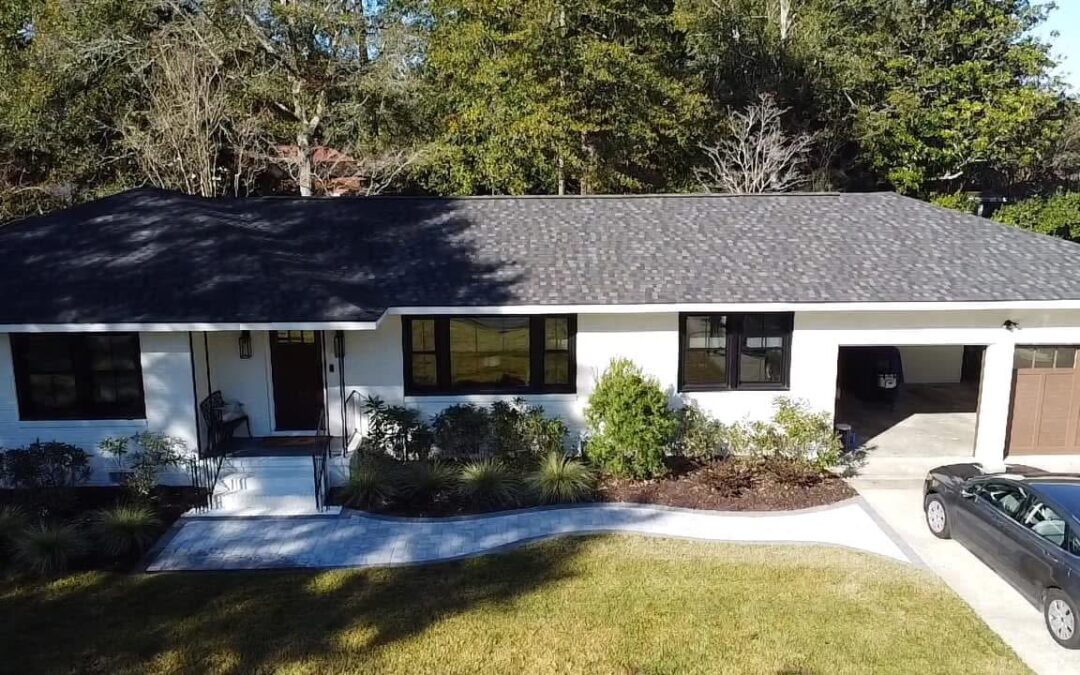
Roof Replacement — Raleigh, NC
Do you need a permit to replace a roof in Raleigh NC? It depends on the price, the decking, and your address. The State Fire Marshal’s office reads G.S. § 160D-1110(c) to exempt a straight roof replacement costing $40,000 or less, with up to 15% of the deck replaced. Go past either line, or repair or replace rafters or trusses, and you need a permit. The City of Raleigh’s permit page also lists roofing as permit work, so check with your inspections office before work starts. Big Bear Roofing replaces roofs across Raleigh and the Triangle.
Updated October 2026 · 18 min read · GAF Master Elite contractor
Key points
- The statute says “forty thousand dollars ($40,000) or less.” That is an at-or-below test. It is not “less than $40,000,” and a paraphrase that flips it is wrong.
- The dollar test is only the first gate. Six carve-outs sit behind it, and the first one — load-bearing structure — is the one a re-roof can run into.
- North Carolina puts a number on it: replacing up to 15% of the total roof deck is not structural work, and the State Fire Marshal’s office reads the cost exemption to cover a roof replacement inside that line. Above 15%, the job falls outside that safe harbor and has to be treated as structural until the local code official says otherwise.
- North Carolina is still on the 2018 code in September 2026. The 2024 edition was delayed by House Bill 47 / Session Law 2025-2, and its effective date is tied to a certification, not a calendar date.
- The general-contractor license line is $40,000 or more, raised from $30,000 by House Bill 488, effective October 1, 2023. Sources still printing $30,000 are three years out of date.
- A Raleigh re-roof permit is priced as a Level 1 Alteration — 28% of the calculated building permit fee. The 0.38% figure you will find on calculator sites is the new construction rate.
Ask the internet whether a Raleigh roof replacement needs a permit and you will get a confident, oversimplified answer: no, North Carolina exempts anything under $40,000. That sentence gets three things wrong at once — the threshold’s wording, what the exemption actually covers, and what happens if your roofer’s crew pulls the old shingles off and finds more bad decking than the state’s safe harbor allows.
Here is the real answer, with the statute quoted and the numbers attached to their sources. Every citation below was checked against its official source on September 10, 2026, or on October 5, 2026 for the State Fire Marshal’s guidance paper and the City of Raleigh’s permit page.
The State Rule: G.S. § 160D-1110(c) and What “$40,000 or Less” Does Not Cover
What the statute actually says
North Carolina’s permit-cost exemption lives in G.S. § 160D-1110(c). Here is the operative language, verbatim from the General Assembly’s own published text at ncleg.gov:
“No permit issued under Article 9 of Chapter 143 of the General Statutes is required for any construction, installation, repair, replacement, or alteration costing forty thousand dollars ($40,000) or less and performed in accordance with the current edition of the North Carolina State Building Code in any single-family residence, farm building, or commercial building unless the work involves any of the following: (1) The addition, repair, or replacement of load-bearing structures. However, no permit is required for replacement of windows, doors, exterior siding, or the pickets, railings, stair treads, and decking of porches and exterior decks that otherwise meet the requirements of this subsection. (2) The addition or change in the design of plumbing. However, no permit is required for replacements otherwise meeting the requirements of this subsection that do not change size or capacity. (3) The addition, replacement, or change in the design of heating, air-conditioning, or electrical wiring, devices, appliances, or equipment, other than like-kind replacement of electrical devices and lighting fixtures. (4) The use of materials not permitted by the North Carolina State Building Code. (5) The addition of roofing, excluding replacement. (6) Any changes to which the North Carolina Fire Code applies.”
Two details in that paragraph are worth slowing down for.
“$40,000 or less” is an at-or-below test
The statute says “costing forty thousand dollars ($40,000) or less.” A job priced at exactly $40,000.00 is inside the dollar test. Plenty of secondary sources paraphrase this as “less than $40,000,” which quietly moves the line and can put a homeowner on the wrong side of it. Do not accept the paraphrase — the wording is “$40,000 or less.”
The statutory credits published with the section run through S.L. 2024-49. As of September 2026 there is no 2025 or 2026 session law amending § 160D-1110, so this is the current text.
What carve-out (5) does and does not do
Carve-out (5), “The addition of roofing, excluding replacement,” confuses almost everyone who reads it, because it is written as a double negative.
The list is a list of things that knock out the exemption. So adding roofing is knocked out, and needs a permit. Replacement is expressly excluded from that carve-out, which means a straight tear-off-and-replace is not disqualified by item (5).
The Office of State Fire Marshal reads it the same way. Its guidance paper on § 160D-1110(c), dated October 19, 2023, asks whether item (5) is meant to exempt the replacement of roofing from permits, and answers yes, with a limit: the exemption covers only “the replacement of roofing and up to 15% of the total existing roof deck for projects costing $40,000 or less.” The paper points to the R908.3 deck rule covered below, and notes that its guidance is not legal advice.
That is why item (5) is not the one that decides your project. Item (1) is.
The one thing this exemption is not: a pass on local permitting
Read the opening words again: “No permit issued under Article 9 of Chapter 143 of the General Statutes is required…” Article 9 of Chapter 143 is the state building-code framework. This is a state cost threshold, and it is not written as a blanket license to skip whatever your city or county requires.
Subsection (a) of the same statute sets the baseline the exemption carves out of, and it is broader than the Building Code alone. It requires “securing all permits required by the North Carolina State Building Code and any other State or local laws” before you start work. Local requirements survive the dollar test. Before assuming a permit is unnecessary, confirm it with the jurisdiction that actually has your address — and see the Raleigh-versus-Wake-County section below, because those are two different offices with two different fee schedules.
Inside Raleigh’s city limits, that check matters. The City’s residential-permit page lists roofing among the projects that “require a permit but do not require plans.” Ask the City before work starts whether your job needs one, rather than assuming the state exemption settles it.
The separate $40,000 you should also know about: the contractor license
There is a second $40,000 in North Carolina roofing, and it is not the same rule.
Any person or firm undertaking a project where the cost of the undertaking is $40,000 or more must hold a General Contractor license from the North Carolina Licensing Board for General Contractors (NCLBGC). That threshold was raised from the long-standing $30,000 by House Bill 488 (Session Law 2023-108), effective October 1, 2023.
A great deal of the roofing content still online was written against the old $30,000 number. If a page tells you the license line is $30,000, that figure is out of date, and you should be skeptical of the rest of it too.
The Board issues limited, intermediate, and unlimited licenses, which cap the value of an individual project a contractor may take on, and it also recognizes a specialty S (Roofing) classification. Verify any contractor’s license on the NCLBGC’s own license lookup rather than on a badge on a website.
The Decking Carve-Out — the Line a Re-Roof Can Cross
Item (1) strips the exemption from any work involving “the addition, repair, or replacement of load-bearing structures.” For a roof, the question becomes concrete fast: is the sheathing under your shingles a load-bearing structure?
North Carolina answered that with a number.
The 15% rule, in the state’s own words
The North Carolina Building Code Council adopted an amendment to Section R908.3 of the 2018 NC Residential Code — published in the Office of State Fire Marshal’s compilation of approved amendments, with a delayed effective date of January 1, 2022 — that reads:
“R908.3 Roof replacement. Roof replacement shall include the removal of existing layers of roof coverings down to the roof deck and replacement of up to 15% of the total existing roof deck. Replacement of up to 15% of the total roof deck shall not be considered structural work.”
Read the boundary in that last sentence carefully. Up to 15% of the deck is expressly not structural work, so the § 160D-1110(c) cost exemption can still apply. The amendment does not write out the converse in so many words — what it does is end the safe harbor. Above 15%, the deck work sits outside the protection of that sentence, item (1) is squarely in play, and the job has to be treated as requiring a permit regardless of cost unless the local code official rules otherwise.
How that plays out on an actual tear-off
Nobody knows how much decking is bad until the shingles are off. That is the whole problem with treating the dollar test as the answer.
Picture a Raleigh-area homeowner with a $15,000 quote for a full tear-off and replacement. That is comfortably inside “$40,000 or less,” so on the dollar test alone, no state permit. Before signing, the homeowner checks with the inspections office for the address and is told the job, as quoted, needs no permit. The contract spells out what happens if deck replacement passes 15%. The crew strips the old shingles and finds roughly 20% of the sheathing soft from years of a poorly ventilated attic.
At that moment the job changes character. Replacing 20% of the deck is past the 15% line, so the safe harbor is gone, item (1) is in play, and the cost exemption can no longer be relied on. The price never moved — the scope did. Subsection (a) says no one may “commence or proceed” without first securing the required permits, so the right response is the step the contract already spells out: stop, confirm with the permitting office, pull the permit, and get the decking inspected before new underlayment goes down.
This is the single most useful thing to understand before you sign a roofing contract in the Triangle: confirm the permit question with the office that covers your address before work starts, and write the stop-and-permit step into the contract in case decking replacement crosses 15%. Ask your contractor, in writing, what happens if it does.
Rafters and trusses are a different conversation
The 15% allowance is written about the roof deck. Framing is not deck. If a rafter is cracked or a truss is damaged and has to be repaired or replaced, that is work on load-bearing structure in its own right, and there is no percentage grace built into item (1) for it.
Where the “25% rule” actually comes from
You will run into a “25% rule” in roofing forums and third-party guides, usually stated as though it were the permit trigger. It is not the same thing.
It does not come from the statute: § 160D-1110(c) contains no percentage at all. Some jurisdictions do use a surface-area threshold administratively as a trigger for review. But the statewide structural line for permitting purposes is the 15% deck rule — that is the one written into the North Carolina amendment, and that is the one to plan around.
Which Code Applies in 2026: Why North Carolina Is Still on the 2018 Edition
The 2018 code is still the enforceable standard
As of September 2026, North Carolina remains on the 2018 NC State Building Code and the 2018 NC Residential Code. If a contractor, a plans examiner, or an article tells you your Raleigh re-roof is governed by the 2024 edition, that is wrong.
What delayed the 2024 code, and why there is no date on it
The Building Code Council adopted a 2024 Code collection with an effective date of July 1, 2025. It never took effect on that date.
House Bill 47 — enacted as Session Law 2025-2, the Disaster Recovery Act of 2025 – Part I, signed by Governor Josh Stein on March 20, 2025 — includes a section titled “Delay 2024 North Carolina State Building Code Effective Date.” Its Section 5.12(b) provides that, notwithstanding G.S. § 143-138(d) or any other provision to the contrary, the 2024 Code
“shall become effective 12 months after the first day of the month following the date the State Fire Marshal certifies, by letter to the Revisor of Statutes … that both of the following events have occurred:”
and then lists two conditions: that the Building Code Council and the new Residential Code Council have completed the initial publication and printing of the adopted 2024 Code, distributed copies to the State and local officials entitled to them, and made copies available for public purchase; and that the Residential Code Council is fully constituted under the membership requirements of G.S. § 143-136.1.
That is the part most summaries miss. The 2024 code’s effective date is not a date on the calendar — it is a certification plus twelve months. Until the State Fire Marshal sends that letter and a year runs, the 2018 edition is what your inspector enforces. The 2024 provisions can be used as an alternate method of construction on request, but they are not the default standard.
What the 2018 code requires on a Raleigh asphalt-shingle roof
Roof coverings sit in Chapter 9, Roof Assemblies. The provisions a homeowner is most likely to see argued about:
- Slope. Asphalt shingles require a minimum slope of 2:12 — two inches of rise for every twelve inches of horizontal run. Between 2:12 and 4:12, the underlayment requirements step up to a double-coverage application. Below 2:12 you are into low-slope territory, which is a membrane system, not shingles.
- Underlayment. Required over the deck, with the type driven by slope and covering.
- Drip edge — read this one carefully. North Carolina amended out the model code’s drip-edge mandate. The state’s approved amendment to R905.2.8.5 deletes the section and states that drip edge is “Not required unless required by the roof covering manufacturer installation instructions.” So whether drip edge is required on your roof depends on the shingle manufacturer’s published installation instructions — which, for a warrantable system installation, is usually the document that governs anyway. It is a fair question to put to any bidder.
- Ice barrier. The eave ice-barrier membrane is a cold-climate provision. It applies in North Carolina’s mountain counties. It does not apply in Raleigh.
Wind and fastening in the Triangle
Wake County is inland Piedmont, not coast, and the design numbers reflect that. Raleigh and Wake County sit in the inland band of roughly 90 to 110 mph ultimate design wind speed (V_ult), with Wake County toward the upper end of it. The North Carolina coast — the Outer Banks and the southeastern counties — runs roughly 130 to 155+ mph and carries a different set of requirements entirely. A roof designed to Raleigh’s numbers is not a coastal roof, and a page quoting coastal wind speeds is not describing your house.
Two things people routinely get wrong about that number:
- V_ult is a 3-second gust, measured 33 feet above open ground, used to calculate the extreme load a building must survive. It is not a sustained wind speed and not a forecast.
- An uplift rating in pounds per square foot is not a wind speed. A rating like “FM 1-90” means 90 pounds per square foot of uplift pressure, not 90 mph. Anyone converting one to the other for you is guessing.
On shingle wind classifications, the code accepts a label showing compliance with either of two ASTM standards, and the current class values are:
| Standard | Classes and speeds |
|---|---|
| ASTM D3161 (fan-induced method) | Class A = 60 mph · Class D = 90 mph · Class F = 110 mph |
| ASTM D7158 (uplift force/resistance method) | Class D ≤ 116 mph · Class G ≤ 155 mph · Class H ≤ 194 mph |
⚠️ A lot of competing content still prints the D7158 classes as 90/120/150 mph. Those are the legacy figures. The current, code-correct values are 116 / 155 / 194, and most premium architectural shingles carry D3161 Class F together with D7158 Class H.
On fastening, the 2018 code sets a minimum of four nails per shingle for standard applications, and it is specific about the fastener itself: corrosion-resistant roofing nails long enough to penetrate through the roofing materials and not less than ¾ inch into the roof sheathing — or completely through the sheathing where it is thinner than that. Six-nail patterns are common on higher-wind applications and are frequently what a manufacturer’s enhanced wind-warranty coverage requires, so it is worth asking which pattern a bid is priced for.
Raleigh and Wake County in Practice: Level 1 Alteration Fees, Inspections, and Who Pulls the Permit
First: find out which office your address answers to
A “Raleigh, NC” mailing address does not mean the City of Raleigh issues your permit. Properties inside the city limits are permitted by the City; properties in unincorporated Wake County are permitted by the County, under a different process and a different fee schedule. Confirm which one applies to your parcel before anyone files anything — the mailing address is not the test.
How the City of Raleigh prices a re-roof
The City classifies a re-roof as a Level 1 Alteration — its fee guide describes that category as the removal and replacement of the covering of existing materials, elements, equipment, or fixtures with new ones serving the same purpose.
A Level 1 Alteration is priced at 28% of the calculated building permit fee, with the City’s minimum trade permit fees applying. Those figures live in the City of Raleigh Development Fee Guide currently in effect — the FY27 guide, covering July 1, 2026 through June 30, 2027 — which the City republishes each fiscal year. Because the schedule is reissued annually, check the current guide rather than any number you find quoted on a blog, including this one.
Two corrections worth carrying into your next conversation with a roofer:
- The 0.38% figure is not the re-roof rate. That percentage of calculated construction value is the base rate for new residential construction building permits. Applying it to a re-roof produces a number that is simply wrong.
- The fixed “minimum permit fee” figure circulating on third-party permit-calculator sites is not a re-roof floor. The minimum that can apply to a re-roof is the City’s own minimum trade permit fee, set in the current guide. Treat calculator sites as unreliable here.
Unincorporated Wake County
Wake County’s schedule is far easier to read. For residential additions, alterations, and accessory structures, the County publishes:
“Residential Permit Fee $75 plus $0.25 per square foot of gross floor area.”
The County notes that the residential permit fee includes all trades required. No fiscal year appears on that page, so treat the figure as current-as-published rather than tied to a budget year, and confirm it when you apply.
Inspections: confirm the stages when the permit is issued
When a Triangle roof replacement is permitted, expect more than a single visit at the end. The one that matters most is the in-progress inspection — the dry-in or decking inspection, done after tear-off and any deck repair, before the new covering goes on — because it is the only opportunity anyone has to look at the deck your roof is fastened to. A final inspection follows. The exact sequence and the stages required depend on the jurisdiction, the permit scope, and the inspector, so confirm the required inspection stages with the issuing office when the permit is issued. A contractor who wants to shingle over the deck before a required in-progress inspection is asking you to give up an inspection you are paying for.
An issued permit is generally valid for a limited window — commonly about six months — if work has not begun, so do not pull one far ahead of the job.
Who is supposed to pull it
The licensed contractor performing the work should be the applicant of record. That is the normal arrangement, and it puts responsibility for code compliance where the expertise is.
North Carolina does allow an owner-builder exemption under G.S. § 87-1, which lets a property owner act as their own general contractor on a building intended solely for occupancy by the owner and the owner’s family. The 12-month point people repeat is not a flat ban on selling: under the statute, offering the property for sale or lease within 12 months of completion is evidence bearing on whether it was really intended solely for the owner’s occupancy — which is the condition the exemption rests on. Confirm eligibility with the permitting authority before relying on it. Either way, it moves the burden of code compliance and subcontractor oversight squarely onto the homeowner, and for a roof replacement there is very little upside in taking that on.
What happens if the permit gets skipped
Skipping a required permit is not a paperwork oversight in North Carolina.
- It is a crime under the statute itself. § 160D-1110 ends with subsection (i): “Violation of this section is a Class 1 misdemeanor.“
- A local inspection department can stop the job. Stop-work authority sits with the local government under G.S. § 160D-404.
- Local penalties stack. Both the City of Raleigh and Wake County impose civil penalties for building-code violations, and Raleigh additionally charges an administrative fee tied to the cost of the permit that should have been pulled, with escalating penalties for repeat violations in a 12-month period.
- It follows you to closing. North Carolina sellers complete the Residential Property Disclosure Statement required by the North Carolina Real Estate Commission, which asks about known unpermitted structural additions or alterations. Unpermitted structural roof work is exactly the kind of thing that surfaces during a sale — and failing to disclose a known problem is its own exposure.
Where we come in
Big Bear Roofing works the Triangle from our North Carolina operation. We are a GAF Master Elite contractor — a certification GAF reserves for roughly the top 2% of its roofing contractors. We handle roof replacement and repair for Raleigh and the surrounding Triangle, including Wake County, and we offer free, no-obligation roof inspections, including drone-assisted looks at slopes nobody should be walking on. Our phones are answered 24/7.
If you are collecting bids right now, put one question to every roofer on your list: what do you do if more than 15% of my decking has to come off? The answer tells you most of what you need to know.
Do You Need a Permit to Replace a Roof in Raleigh NC? The Questions Homeowners Ask
Do you need a permit to replace a roof in Raleigh NC if the job is inside the $40,000 threshold? Not under state law, if it is a straight replacement and no more than 15% of the roof deck is replaced. G.S. § 160D-1110(c) exempts work “costing forty thousand dollars ($40,000) or less,” and the State Fire Marshal’s office reads that exemption to cover “the replacement of roofing and up to 15% of the total existing roof deck.” Past 15% of the deck, or once rafters, trusses, or other load-bearing structure must be repaired or replaced, the exemption no longer applies, and how much decking has to come off is not fully known until the old covering is removed. Check the local rule too: the City of Raleigh’s residential-permit page lists roofing among projects that “require a permit but do not require plans.” Confirm with the inspections office that covers your address before work starts, and put the over-15% decking step in your contract.
Is the threshold $40,000, or under $40,000? It is “$40,000 or less” — an at-or-below test, in the statute’s own words. A job costing exactly $40,000 is inside the dollar test. Sources that say “less than $40,000” are paraphrasing it incorrectly.
How much decking can be replaced before a permit is required? Up to 15% of the total existing roof deck. The North Carolina amendment to Section R908.3 of the 2018 NC Residential Code states that replacement of up to 15% of the total roof deck “shall not be considered structural work.” Above that line the safe harbor ends, the load-bearing carve-out is in play, and the cost exemption should not be relied on without confirming with the local code official.
Is North Carolina on the 2024 building code yet? No. As of September 2026 the 2018 NC State Building Code and 2018 NC Residential Code still govern. House Bill 47 (Session Law 2025-2), signed March 20, 2025, delayed the 2024 edition and tied its effective date to a State Fire Marshal certification plus twelve months, rather than to a fixed date.
Does my roofer need a general contractor’s license? A General Contractor license is required for any undertaking costing $40,000 or more. That threshold was raised from $30,000 by House Bill 488, effective October 1, 2023. North Carolina also recognizes a specialty S (Roofing) classification. Verify any license through the NCLBGC’s own lookup.
What does a Raleigh re-roof permit cost? The City prices a re-roof as a Level 1 Alteration at 28% of the calculated building permit fee, with minimum trade permit fees applying, per the City’s current Development Fee Guide (FY27). The 0.38% rate you may see quoted is for new residential construction, not a re-roof, and the fixed minimum quoted on third-party calculator sites is not a re-roof floor.
Who pulls the permit — me or my roofer? The licensed contractor doing the work should be the applicant of record. North Carolina’s owner-builder exemption under G.S. § 87-1 lets an owner pull their own permit for a building intended solely for occupancy by the owner and the owner’s family, but it transfers responsibility for code compliance to the homeowner — and offering the property for sale or lease within 12 months of completion is evidence bearing against the exemption. Confirm eligibility with the permitting authority before relying on it.
What happens if the work gets done without a permit? Violation of § 160D-1110 is a Class 1 misdemeanor under subsection (i) of the statute. A local inspection department can issue a stop-work order under G.S. § 160D-404, local civil penalties apply, and unpermitted structural work has to be reckoned with on the Residential Property Disclosure Statement when the home is sold.
Not Sure Whether Your Roof Replacement Needs a Permit?
You should not have to interpret a building-code statute to buy a roof. That is our job. For a Triangle re-roof, the permit question turns on three things: the price, what turns up under the old shingles, and what the office that covers your address requires. The first and the last can be confirmed before you sign.
Start with a free, no-obligation roof inspection. We will tell you what we can actually see, what the job is likely to involve, and how the permit question is likely to land — and we will be straight with you that the true condition of the decking under an existing roof is not fully knowable until the old covering comes off. That is exactly why the contingency belongs in the contract before you sign it.
Call 919-568-3931 or request your free inspection online.
Related reading: What a Roof Replacement Costs in Raleigh in 2026 · How to Verify a Roofing Contractor in North Carolina
Authored by Colin Blocksma, Director of North Carolina Operations, Big Bear Roofing & Exteriors. This article is educational and is not a substitute for legal advice or for confirmation from the permitting office that has jurisdiction over your address.