
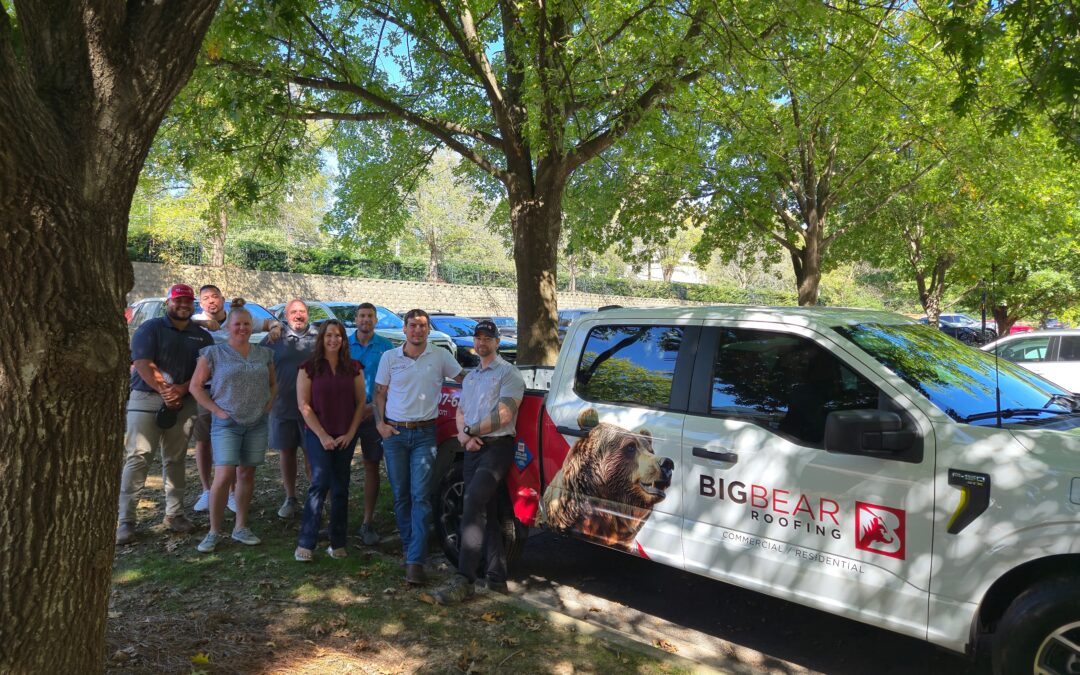
Hiring a Roofer — Raleigh & North Carolina
In North Carolina, a general contractor license is required on any roofing project costing $40,000 or more — raised from $30,000 by House Bill 488 on October 1, 2023. Ask for the license number, check it today on the state board’s own search, confirm the classification covers roofing, and have the insurer email you the certificate of insurance directly.
Key points
- Check the license number on the NCLBGC’s own lookup — status, classification, limit, expiration.
- Have the insurance agent email you the certificate, naming you as certificate holder.
- Put permit responsibility on the contractor in writing, and confirm the process with the issuing office.
- A license is legal authority; a certification is warranty access; insurance is your protection.
- Any offer to pay, rebate or absorb your deductible is insurance fraud in North Carolina.
South Carolina licenses and regulates roofers differently; Charleston-area homeowners get their own guide.
1. Licensing in North Carolina, in plain numbers
Anyone who bids on, constructs or superintends a project costing $40,000 or more must hold a license from the North Carolina Licensing Board for General Contractors under N.C.G.S. § 87-1 — raised from $30,000 by House Bill 488 on October 1, 2023.
Two other fields matter as much: the classification must authorize roofing, and the limitation — the financial tier — must cover your job’s value. Big Bear Roofing & Exteriors holds a North Carolina general contractor license with the roofing classification. For larger replacements, see our page on roofing contractor options in Raleigh.
If they are not licensed, your contract may be worth less than you think
Contracting without a required license is a Class 2 misdemeanor under N.C.G.S. § 87-13, and under Brady v. Fulghum (N.C. Supreme Court, 1983) an unlicensed general contractor cannot enforce its own contract or fall back on unjust enrichment.
2. How to verify a license in five minutes
Licenses expire, get suspended, and often belong to a different entity than your proposal names.
Search the NCLBGC portal at portal.nclbgc.org/Public/Search, ideally by license number, since contractors frequently trade under a “doing business as” name. Then read four fields:
- Status — it must read Active. An expired or suspended license means the contractor cannot act as a licensed general contractor on a job that requires one — $40,000 or more under N.C.G.S. § 87-1 — and must not represent itself as actively licensed.
- Expiration — these licenses run on the calendar year and lapse December 31.
- Classification — a Building classification, or a roofing specialty classification.
- Limitation — Limited, Intermediate or Unlimited, covering your project’s value.
Then the check almost nobody does: confirm the name on the state record is the legal entity printed on your contract — the classic storm-chaser gap, and much of what separates the top-rated roofers in Raleigh from post-hailstorm trucks.
3. Insurance: general liability and workers’ compensation
You want two policies: general liability for damage to your property, workers’ compensation for injury to the crew. Never accept a certificate from the salesperson — have the agent or insurer email it directly to you, naming you as the certificate holder. That is good evidence, and the way to catch a forged or expired certificate — but read the form’s own disclaimer. A standard ACORD 25 certificate is “issued as a matter of information only and confers no rights upon the certificate holder,” and it does not amend, extend or alter the coverage the policies afford. Confirm current coverage with the insurer. And if you are to be an additional insured, the policy itself must carry additional-insured provisions or be endorsed — a statement on the certificate does not confer that in its place.
Under N.C.G.S. § 97-2(1), any business regularly employing three or more people must carry workers’ compensation, counting part-time workers, seasonal help and corporate officers who elect out of coverage. And “we use 1099 subs” does not solve it: under N.C.G.S. § 97-19, liability for an uninsured subcontractor’s workplace injury flows up to the general contractor.
Workers’ compensation also carries an “exclusive remedy” shield for a covered employee’s claim. Without it, an injured worker may look elsewhere for recovery, and depending on the facts that can include a claim against the homeowner. Which is why the rule stands: demand a certificate showing both.
4. Permits: who pulls them, and when one is required
The contract should assign permit responsibility to the contractor. Who may actually apply depends on the city or county’s process, so confirm the owner-builder rules with the issuing office. Never pull a permit yourself to work around a contractor’s licensing.
The $40,000 line is a state threshold, not a local exemption
N.C.G.S. § 160D-1110(c) says no permit is required under Article 9 of Chapter 143 for work “costing forty thousand dollars ($40,000) or less” on a single-family residence, farm building or commercial building, performed in accordance with the North Carolina State Building Code — unless the work involves one of six listed carve-outs.
That is not a blanket local exemption. Subsection (a) says no person shall begin work “without first securing all permits required by the North Carolina State Building Code and any other State or local laws”. Subsection (c) is a state cost threshold carved out of (a); it does not touch your city’s or county’s requirements. Two of the six carve-outs bite on roofs:
- Carve-out (1), load-bearing structures, requires a permit at any cost. North Carolina’s amendment to Residential Code section R908.3 puts that line at the deck: replacement of “up to 15% of the total existing roof deck … shall not be considered structural work”. Past 15%, a permit is required regardless of price. The familiar “more than 25% of the roof” figure is an administrative convention, not the statewide structural trigger.
- Carve-out (5), “the addition of roofing, excluding replacement,” is a double negative. The carve-outs are what knock out the exemption, and replacement is excluded from this one — so a straight tear-off and replacement is not disqualified by item (5).
Violation of the section is a Class 1 misdemeanor under § 160D-1110(i). North Carolina enforces the 2018 NC Residential Code; the 2024 edition takes effect twelve months after the State Fire Marshal certifies the statutory conditions, and no calendar date has been published.
5. Manufacturer certifications: what they mean and what they do not
A manufacturer certification is not a state license, a state license is not a certification, and neither one is insurance.
GAF’s tiers map onto warranty access: System Plus is available to GAF Certified, Certified Plus and Master Elite contractors; Silver Pledge to Certified Plus and Master Elite; the Golden Pledge to Master Elite contractors only. GAF’s 2026 program guidelines state that “only 2% of roofers in North America are invited to become GAF Master Elite Contractors,” and that Master Elite contractors “are insured and licensed in states where they operate if licensing is required”; since January 1, 2025 they must also meet annual minimum renewal requirements. Big Bear Roofing & Exteriors is a GAF Master Elite contractor.
Two limits: a certification is not proof that a particular policy is in force today, so confirm current coverage with the insurer; and it is product-specific — solar shingles require a separate GAF Energy certification, distinct from Master Elite.
6. Reading a warranty before you sign
“Lifetime” is a limited warranty: it lasts as long as the original owner owns the home, and it prorates after an initial non-prorated period. Material-defect coverage is also not workmanship coverage — a defective shingle is the manufacturer’s problem, a badly nailed one is the installer’s. On GAF’s current published terms:
- System Plus — lifetime limited manufacturing-defect coverage with a 50-year period at 100% (non-prorated), tear-off and disposal included, and no workmanship coverage.
- Silver Pledge — the same, plus 10 years of workmanship coverage.
- Golden Pledge — the same, plus 25 years of workmanship coverage (30 years with Timberline UHDZ shingles). Master Elite only.
All three transfer once to a new owner within 20 years and carry a 15-year wind warranty term.
Ask what voids it: inadequate attic ventilation, shingles laid over the old roof instead of a tear-off to the deck, and unauthorized alterations. The longer version is in our complete guide to roof warranties.
7. The contract, and your three-day right to cancel
A contract should name the exact legal entity and its license number, the scope, the materials and the payment schedule. A deposit that buys materials is normal; one that funds most of the job up front is not.
Federal law adds a protection most homeowners never hear about. Under 16 C.F.R. § 429.0(a), a door-to-door sale is one where your agreement to buy is made somewhere other than the seller’s place of business — at a purchase price of $25 or more when the sale is made at your home, or $130 or more when it is made anywhere else away from the seller’s own place of business, such as a hotel meeting room, a fairground booth or your workplace. A sale at the seller’s own permanent place of business is not a door-to-door sale at all. Six exclusions follow, and one can bite on a roofing sale: a transaction you initiate where the work meets a bona fide immediate personal emergency and you give the seller a separate dated, signed, handwritten statement expressly waiving the right to cancel (§ 429.0(a)(3)); the buyer-requested repair exclusion at (a)(5) reaches your personal property, not a roof. Where the Rule does apply, § 429.1 requires the seller to furnish a fully completed receipt or copy of the contract at signing plus a completed Notice of Cancellation in duplicate, and you have three business days to cancel — any calendar day except Sunday or a federal holiday counts, so Saturday does.
8. The red flags, and the law behind each one
- “We’ll cover your deductible,” or an offer of a no-cost roof. North Carolina treats paying or hiding a homeowner’s insurance deductible as insurance fraud. Billing the insurer at full price while privately charging you less is the mechanism.
- “We’ll handle your claim” or “we’ll get the whole roof approved.” A contractor may inspect, document damage and estimate to support your claim. Negotiating the claim value, interpreting your policy or advising you on your insurance rights is the unlicensed practice of public adjusting — North Carolina licenses public adjusters under G.S. § 58-33A-10. Nobody can guarantee how an insurer will rule. Here is how a North Carolina roof insurance claim actually proceeds.
- Pressure to sign an assignment of benefits, which hands your insurance rights, the claim and the payment to the contractor.
- Out-of-state plates after a storm. Storm-chasing crews frequently lack state licensing and any local presence — the NCLBGC portal settles it in seconds.
- Cash only, a large deposit before anything arrives, or no physical address — the first two suggest no vendor credit. A company without a public address can still be reached through its registered agent or the address on its license and corporate records, but the absence is a reason to keep looking.
- A one-number quote with no scope. Without underlayment type, flashing, ventilation and a decking allowance, that is a sales measurement, not an estimate.
9. What a real roof inspection produces
The difference between an inspection and a sales call is the deliverable: one produces a documented, photographed, itemized assessment, the other a number. The ASHI and InterNACHI standards require the specified roof components to be inspected and the method used to be disclosed; an inspector need not walk a surface that is unsafe or could be damaged. A useful report covers the decking, checked from the attic side for moisture staining, daylight and sag; ventilation, since poor ventilation can void warranty coverage; and flashing and penetrations at chimneys, skylights, vents and valleys, common places for roof leaks to start. Where a drone is flown commercially, the remote pilot in command holds the FAA Part 107 certificate and stays current on recurrent training; anyone else on the controls works under that pilot’s direct supervision, with the pilot able to take immediate control.
Big Bear’s roof inspections are free, no-obligation, including drone-assisted when appropriate. For why that beats a patch quote, see why professional roof repair is worth it.
Ten questions to ask before you sign
Print this.
- What is your license number, and what legal name is it issued to?
- Does that name match the entity on this contract?
- What classification and limitation does it carry?
- Will your agent email me the certificate, naming me as certificate holder?
- Does it show both general liability and workers’ compensation?
- Are the people on my roof employees or covered subcontractors?
- Who pulls the permit, and which office issues it?
- What manufacturer certification do you hold, and which warranty does it allow?
- Will you register that warranty and send me the confirmation?
- What is the written scope — underlayment, flashing, ventilation, decking allowance?
Frequently asked questions
Does a roofer need a license in North Carolina?
Yes, once the project costs $40,000 or more. The company must then hold a valid license from the North Carolina Licensing Board for General Contractors under N.C.G.S. 87-1, in a tier covering the project value and with a classification that authorizes roofing. House Bill 488 raised that threshold from $30,000 on October 1, 2023.
How do I check a North Carolina roofing license?
Use the state board’s own lookup rather than the contractor’s paperwork. Search portal.nclbgc.org/Public/Search, ideally by license number, since companies often trade under a different name. Confirm the status is Active, the classification covers roofing and the limitation covers your project — then check the licensed name against your contract.
What does GAF Master Elite actually mean?
GAF’s top contractor tier, granted at company level. GAF’s 2026 program guidelines say only 2% of roofers in North America are invited into it, and that since January 1, 2025 they must meet annual renewal requirements. It is the only tier allowed to offer the Golden Pledge warranty.
Do I need a permit to replace a roof in Raleigh?
In Raleigh, yes — the City’s Development Fee Guide classes a re-roof as a Level 1 Alteration with its own permit fee. The $40,000-or-less threshold in G.S. 160D-1110(c) is a state cost threshold only — subsection (a) still requires every permit the North Carolina State Building Code and local law demand. Past 15% of the roof deck, the work is structural and needs a permit at any cost. Your contractor pulls it.
Is it legal for a roofer to cover my deductible?
No. North Carolina treats paying, rebating or hiding a homeowner’s insurance deductible as insurance fraud. The mechanism is a contractor billing the insurer at full price while privately charging you less, and an offer of a no-cost roof is that arrangement in a friendlier wrapper.
Who pulls the permit?
Your contract should put permit responsibility on the contractor. Who may actually apply depends on the city or county’s process, so confirm the owner-builder rules with the issuing office. Never pull a permit to work around a contractor’s licensing — if one asks, check the license before signing.
Want a Roofer Whose Credentials You Can Check Yourself?
Every claim here is one you can verify about any company bidding your roof — including ours. Big Bear Roofing & Exteriors holds a North Carolina general contractor license with the roofing classification and is a GAF Master Elite contractor serving Raleigh and the Triangle; our inspections are free, no-obligation, including drone-assisted when appropriate. Call 919-568-3931 or request your free inspection, and ask us every question above.
Authored by Colin Blocksma, Director of North Carolina Operations, Big Bear Roofing & Exteriors. This article is educational and is not legal advice.