
For a coastal South Carolina home, the three real options are architectural asphalt shingles, standing-seam metal, and solar (integrated shingles or rack-mounted panels). Asphalt is the lowest upfront cost — in the Charleston market it typically runs $350–$600 per square, roughly $7,000–$13,200 for a typical home (Big Bear’s real-world range, August 2026; 2026 aggregator averages run $9,600–$14,800) — but its coastal lifespan is compressed to ~18–25 years by salt and UV. Metal costs more (a full SC coastal metal roof runs roughly $16,000–$34,000; standing seam typically $10–$18 per square foot) but lasts 40–70 years, resists hurricane winds best, and can earn larger insurance discounts — with one critical rule: near the ocean you generally need solid aluminum, not Galvalume steel. Solar adds power generation at a much higher capital cost; note that the 30% federal residential solar tax credit ended for systems completed after Dec 31, 2025. The right choice depends on your distance from the surf, budget, time horizon, and HOA. For tax and insurance specifics, confirm with a CPA, your carrier, and the SC DOI. [SC DOI]
Coastal SC is one of the harshest roofing climates in the country — Category 3+ hurricane winds, relentless UV, thermal cycling, and corrosive salt air. Choosing a roof here is an engineering and financial decision, not just an aesthetic one. This guide compares the three systems on the metrics that actually matter on the coast.
Important: This is general educational information, not engineering, tax, or insurance advice. Costs are 2025/2026 ranges that vary by market and roof complexity — get a scoped estimate. Verify tax credits with a CPA and the IRS, and verify insurance discounts and grant programs with your carrier and the SC DOI.
1. Architectural Asphalt Shingles — the budget baseline
- Cost: In the Charleston market, $350–$600 per square ($3.50–$6.00/sq ft installed) is the real-world range Big Bear sees on actual jobs (August 2026) — roughly $7,000–$13,200 for a typical 1,800–2,200 sq ft home. Aggregators model higher: Modernize’s SC calculator (June 2026) averages $14,800 (range $9,000–$22,500); Angi’s Charleston-metro average is $9,603 (March 2026, full range $5,900–$46,000) — averages and ranges differ widely with home size and model. Coastal code pricing runs ~10–20% above the SC interior (The Roof Cost Guide, May 2026) due to wind-rated underlayment and enhanced fastening.
- Coastal lifespan: ~18–25 years (as low as ~18 oceanfront). Intense UV dries and embrittles the asphalt; airborne salt works into the surface and dislodges the protective granules.
- Wind: building code accepts shingles labeled to *ASTM D3161 or ASTM D7158, and premium architectural shingles routinely carry the top uplift class (D7158 Class H). ⚠️ Two cautions: a manufacturer “no-maximum-wind-speed” warranty is a legal/contractual* promise tied to specific accessories and a precise nailing method — not the same as the independent ASTM rating; and most real-world asphalt failures trace to improper nailing, so installation quality is everything.
- Salt & humidity: poor. Specify hot-dip galvanized or stainless steel nails on the coast to prevent fastener failure, and consider algae-resistant shingles for Lowcountry humidity.
- Energy: least efficient (low solar-reflectance); a dark asphalt roof can hit ~170°F on a summer afternoon. “Cool” shingle lines help modestly.
- Best fit: budget-conscious projects, complex roof geometries where metal/solar labor is prohibitive, and homes several miles inland where salt spray is reduced.
2. Standing-Seam Metal — the coastal fortress
- Cost: roughly $16,000–$34,000 for a full SC coastal metal roof (Modernize, June 2026); standing seam typically runs $10–$18/sq ft (2026 sources), with premium metal or complex geometry to ~$30 — solid aluminum pushes higher. 24-gauge is commonly specified for coastal residential standing seam (it resists “oil-canning”) — final gauge and panel selection follow engineering, manufacturer, and project requirements.
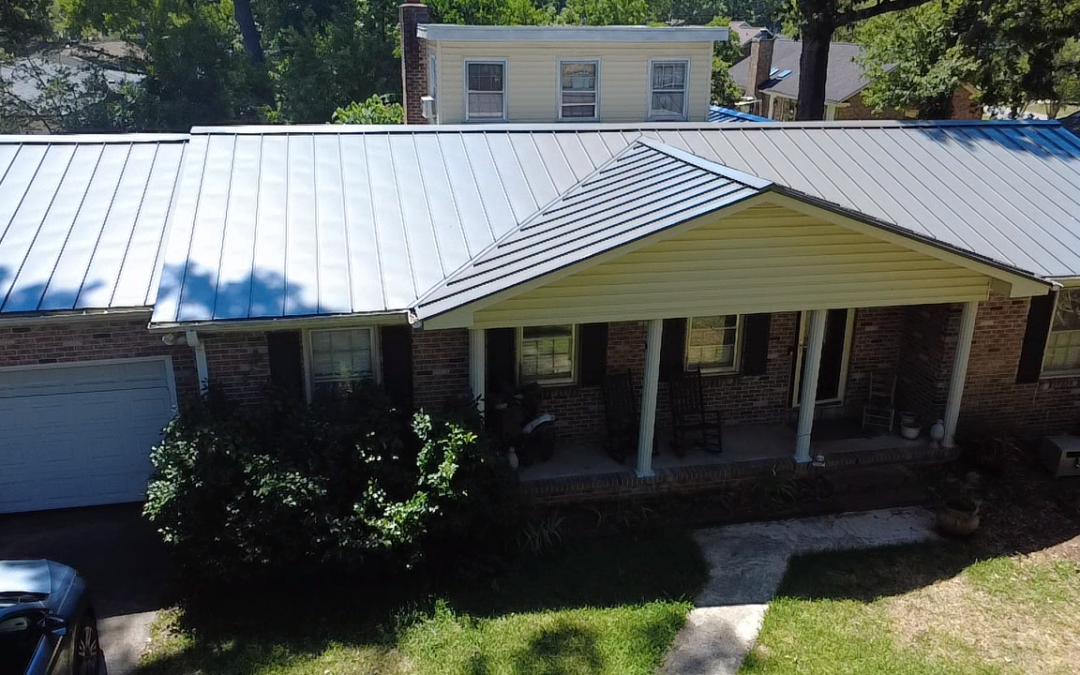
- Lifespan: 40–70 years — two to three times asphalt. Concealed fasteners and floating clips handle thermal movement and eliminate the exposed-screw leak points that doom cheap corrugated metal in salt air.
- Wind: excellent. Mechanically-seamed panels routinely earn a high UL 580 Class 90 uplift rating (a 90-psf pressure rating — not a wind speed) and can be engineered to meet the coast’s design-wind requirements; with the deck attached, panel blow-off risk is minimal.
- The critical coastal decision — Galvalume vs. aluminum:
– Galvalume steel is stronger and ~15–25% cheaper, but its zinc-aluminum coating is sacrificial — salt consumes it and the steel underneath rusts. Manufacturers void Galvalume warranties within set distances of saltwater (varies by maker — commonly cited from ~1,500 ft up to ~2,800 ft of breaking surf, with tighter limits near bays/marshes). Best for homes well inland (e.g., Summerville, inland Berkeley/Dorchester).
– Aluminum is essentially immune to salt corrosion (it forms a self-healing oxide layer) and is the recommended choice for oceanfront and near-water homes — often the only metal that stays warranted that close to saltwater. Confirm the panel metal, coating, fasteners, and distance-to-saltwater exclusions with the manufacturer before specifying.
- Energy: high solar reflectance (light Kynar/PVDF finishes); U.S. Department of Energy-cited cool-roof research puts summer cooling-load reductions at roughly 10–25% versus dark roofs. [1]
- Insurance: metal commonly passes Class 4 impact and Class 90 uplift testing, and carriers may offer meaningful premium discounts (reported ranges vary — see §4).
- Watch-out: many coastal HOAs restrict visible metal roofs — confirm before you commit.
- Best fit: “forever homes,” oceanfront (aluminum), and owners who’ll trade higher upfront cost for longevity, low maintenance, and storm resilience.
3. Solar Roofing — adding power generation
Solar splits into two technologies, and Big Bear’s role here is specific (see below).
- Integrated solar shingles (e.g., GAF Timberline Solar): a “nailable” solar shingle installed alongside conventional shingles — it is the roof. Sits nearly flush (low wind profile, independently rated up to ~130 mph), no rack penetrations to leak, and a single unified roof-and-power warranty. Installed cost is high (2026 manufacturer/industry figures commonly run $35,000–$75,000 gross for a full roof + system [4]), and efficiency runs a bit lower than elevated panels because it can’t air-cool underneath.
- Traditional rack-mounted panels (e.g., Maxeon, Qcells): highest power efficiency and longest power warranties (some to ~40 years), but they bolt through the roof deck — those penetrations can void a roof warranty and create leak points, and on the coast they require marine-grade aluminum racking and stainless fasteners (a commonly-cited $1,500–$2,500 premium, 2026 industry figures [4]). If your roof is aging, replace it before adding panels, or you’ll pay to remove and reinstall the array later.
- ⚠️ Federal tax credit — the big 2026 change: the 30% federal residential solar tax credit (§25D) ended for systems whose installation is completed after December 31, 2025. Do not budget around a 30% (or “26%”) federal credit for a 2026 install — verify current federal, state, and utility incentives with a CPA before relying on any of them. (NC’s Duke “PowerPair” rebate is a different state’s program and doesn’t apply in SC.)
Big Bear’s role with solar: We are a roofing company. Integrated solar shingles require a separate manufacturer solar certification (GAF Energy), distinct from our GAF Master Elite roofing credential. So our job is to make sure your roof is sound, code-correct, and solar-ready for your chosen solar provider — not to act as your solar installer unless and until that’s a service we offer. If you’re weighing solar, we’ll tell you honestly whether your roof should be replaced first.
At a Glance
| Metric | Architectural Asphalt | Standing-Seam Metal | Solar (integrated / panels) |
|---|---|---|---|
| Gross cost (avg home) | ~$7,000–$13,200 typical (Big Bear’s real-world Charleston range, Aug 2026); aggregator averages $9,600–$14,800 | ~$16,000–$34,000 | high capital ($35k–$75k integrated; panels add to a re-roof) |
| Coastal lifespan | ~18–25 yrs | 40–70 yrs | 25–40 yrs power; roof must outlast the array |
| Hurricane wind | top uplift class (D7158 Class H) | engineered to coastal uplift (Class 90) | integrated low-profile; panels strong but rack-failure risk |
| Salt resilience | poor (granule loss) | excellent if aluminum near water | needs marine-grade racks; integrated avoids racks |
| Energy | low reflectance | high reflectance (10–25% cooling savings) | generates power |
| Best for | inland / budget / complex roofs | oceanfront & long-term holds | owners offsetting power, roof already due |
Cost and rating ranges are planning figures from industry data — only a scoped estimate is accurate.
4. South Carolina Wind-Mitigation Incentives
SC’s volatile coastal insurance market has produced real financial incentives to build beyond code — which can shift the math toward a more resilient roof:
- IBHS FORTIFIED Roof — a voluntary, third-party-verified standard (enhanced ring-shank deck nailing, a sealed roof deck secondary water barrier, and high-wind edges/coverings). Both asphalt and metal can be installed to FORTIFIED if the contractor follows the protocol.
- Insurance premium discounts — a FORTIFIED roof can earn a wind-premium discount commonly reported in the ~10–35% range, but this is not a fixed statutory number — it’s set by your carrier. Phrase it as “may earn roughly 10–35%, varies by carrier.”
- SC Safe Home grants — the SC DOI program offers mitigation grants: the Resilient Mitigation Award (SC Safe Home + IBHS FORTIFIED Roof) runs up to $7,500 non-matching for households under 80% of county AMI, or $6,000 matching otherwise, with a Sustainable Mitigation tier at $5,000/$4,000 — and work must begin only after approval. The program opens in short cycles and funds commit fast — the cycle that reopened July 13, 2026 stopped accepting applications within days. Sign up for SC DOI’s reopening notifications and have your scope and documentation ready to apply the day it reopens (current status: doi.sc.gov/safehome). Grants are for mitigation retrofits, not for roofs already paid out on a storm claim.
- SC fortification tax credits — SC offers a state income-tax credit (commonly 25% of fortification cost or $1,000, whichever is less) plus a separate credit (up to $1,500) for sales tax on fortification materials, claimed on SC Schedule TC-43. Confirm current amounts and eligibility with a CPA / SC DOR; note costs already covered by Safe Home grant funds aren’t eligible for the credits.
Frequently Asked Questions
What’s the best roof for a Charleston-area coastal home?
There’s no single answer. Asphalt wins on upfront cost and is fine several miles inland; standing-seam metal (aluminum near the water) is the most durable and storm-resistant for a long-term hold; solar makes sense if you’re already re-roofing and want to offset power. Distance from the surf, budget, and HOA rules usually decide it.
How long does each roof last on the coast?
Roughly 18–25 years for architectural asphalt (less oceanfront), 40–70 years for standing-seam metal, and 25–40 years of power generation for solar (the underlying roof must be able to outlast the array). [Industry data]
Galvalume or aluminum for a coastal metal roof?
Aluminum near the ocean — it’s immune to salt corrosion and is often the only metal that stays warranted close to the water. Galvalume steel is cheaper and excellent well inland, but its coating is sacrificial and manufacturers void the warranty within set distances of saltwater. Confirm your home’s distance to surf/bay/marsh against the manufacturer’s warranty exclusions.
Is there still a 30% federal tax credit for solar in 2026?
No. The 30% federal residential solar credit (§25D) ended for systems completed after December 31, 2025. Verify any current federal, state, or utility incentive with a CPA before budgeting around it.
Does a metal roof lower my insurance in South Carolina?
It can. Metal commonly passes Class 4 impact and Class 90 uplift testing, and a FORTIFIED installation may earn a wind-premium discount (commonly reported ~10–35%, set by your carrier). Ask your insurer what your specific policy allows.
Will solar panels void my roof warranty?
Rack-mounted panels drill through the roof, and those penetrations can void a roof warranty and create leak points — which is why an aging roof should be replaced first. Integrated solar shingles avoid rack penetrations. Always confirm with your roofer and installer before mounting anything.
How Big Bear Helps You Choose
Big Bear Roofing installs both architectural asphalt and standing-seam metal systems across the Charleston Lowcountry, and we’ll give you a straight comparison for your home:
- Free, no-obligation consultation and inspection — including drone-assisted documentation.
- Coastal-correct specification — D7158 Class H shingles with stainless/galvanized fastening, or 24-gauge standing-seam in aluminum where you’re near the water.
- FORTIFIED-aware guidance — we’ll walk the FORTIFIED Roof and SC Safe Home requirements, documentation, and timing with you; eligibility, evaluator, and approved-contractor rules run through SC DOI, IBHS, and your carrier, so verify them before work begins.
- Honest solar guidance — we make sure your roof is sound and solar-ready for your provider, and tell you if it should be replaced first.
As a GAF Master Elite company, we install to current SC building code and stand behind our work. Request a free roof consultation and we’ll help you weigh cost, lifespan, and resilience for your home.
Matt Longo, Owner — Big Bear Roofing, North Charleston, SC. Call 843-544-9537 or request a free consultation online. Serving Charleston, Berkeley, and Dorchester counties.
Sources
1. Architectural asphalt cost, coastal lifespan, salt-degradation, and SRI data — roofing-industry technical references; reflective-metal cooling-load reductions per U.S. DOE-cited cool-roof research (2026 industry syntheses).
2. ASTM D3161 / D7158 wind classifications; UL 2218 impact; UL 580 Class 90 — ASTM / UL standards (see Big Bear domain pack §2–§3).
3. Standing-seam metal cost, lifespan, and Galvalume-vs-aluminum coastal warranty exclusions — metal-manufacturer warranty documents (Drexel Metals, McElroy Metal).
4. Solar systems (GAF Timberline Solar UL 7103 / ~130 mph; Maxeon, Qcells panels) cost, efficiency, and warranties — manufacturer/independent sources.
5. Federal §25D residential solar credit terminated for installs completed after 12/31/2025 (One Big Beautiful Bill, P.L. 119-21) — Congress.gov / IRS. (Corrects an outdated “reduces to 26%” figure still circulating in the market.)
6. IBHS FORTIFIED Roof standard and third-party verification — Insurance Institute for Business & Home Safety. https://fortifiedhome.org
7. SC Safe Home grant program (up to $7,500 Resilient Mitigation Award) and FORTIFIED premium discounts — SC Department of Insurance. https://doi.sc.gov
8. SC fortification tax credits — S.C. Code § 12-6-3660 / § 12-6-3665, SC Schedule TC-43 — SC DOR. https://dor.sc.gov